
AI Impact on Tech Jobs in the UAE: Why Demand Is Rising in 2026
Last reviewed: 19 October 2026
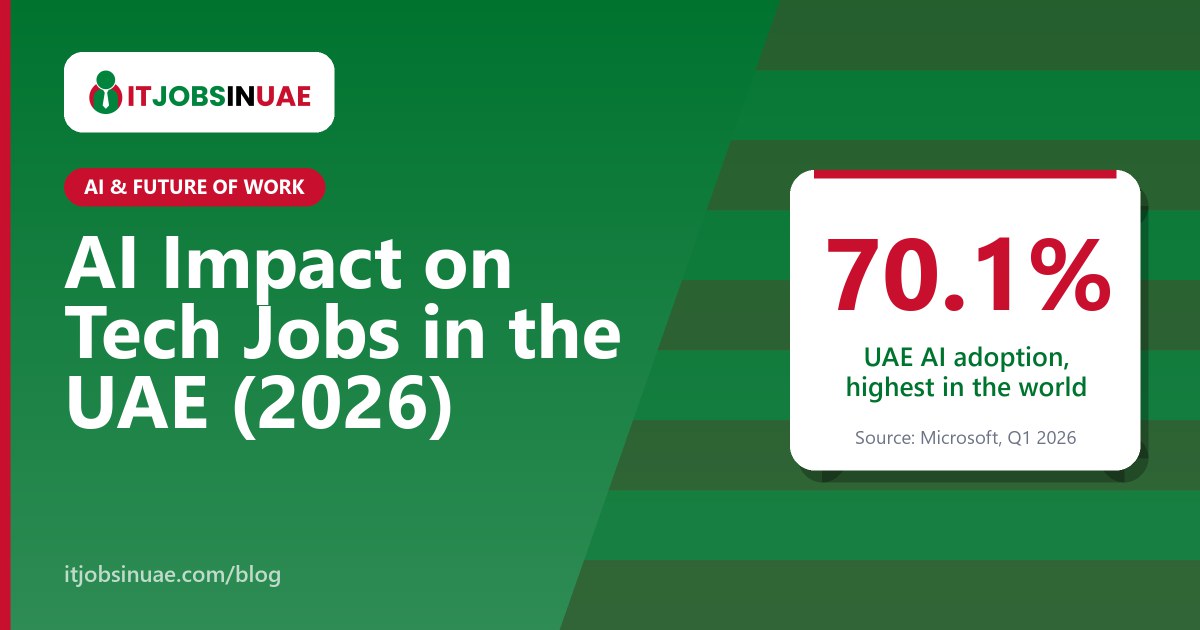
Short answer: the AI impact on tech jobs in the UAE is mostly positive for skilled workers. The UAE has the highest AI adoption in the world: 70.1% of working-age people used generative AI in the first quarter of 2026, against a global average of 17.8% (Microsoft AI Diffusion Report). Employers want people who can build and use it. The share of UAE job ads requiring AI skills more than tripled from about 1% in 2021 to 3.2% in 2025, and AI skills carry wage premiums of up to 92% in financial services (PwC 2026 AI Jobs Barometer).
Key takeaways
- UAE AI adoption: 70.1% of working-age people, first in the world (Microsoft, Q1 2026).
- Job ads requiring AI skills: 3.2% in 2025, up from about 1% in 2021 (PwC).
- AI-skill wage premiums: 92% in financial services, 50% in technology, media and telecoms (PwC).
- 76% of UAE employers report difficulty hiring, above the global average.
- Growing roles: AI/ML engineers, cloud architects, cybersecurity specialists, DevOps.
Is AI creating or cutting tech jobs in the UAE?
In the UAE, AI is mainly creating demand. The government's national AI strategy, huge data centre investments in Abu Dhabi and Dubai, and AI adoption across government services, banking, aviation and real estate all need technical talent. Unlike markets where tech layoffs dominate headlines, UAE employers mostly report the opposite problem: 76% say they struggle to hire, according to PwC.
That doesn't mean every role is safe. Routine work is changing fast here too.
Which tech roles are growing and which are changing?
| Trend | Roles |
|---|---|
| Growing fast | AI and machine learning engineers, data engineers, cloud architects, cybersecurity specialists, DevOps and platform engineers, AI product managers |
| Changing | Software developers, data analysts, business analysts, digital marketers. AI speeds up the work, so employers expect more output. |
| Under pressure | Manual QA, basic IT support, routine content and translation, data entry |
Why do AI skills pay so much more in the UAE?
PwC found that jobs requiring AI skills offer wage premiums of 92% in financial services and 50% in technology, media and telecoms. Demand is outrunning supply, and the UAE recruits globally for these skills. Hiring is also spreading to "AI user" roles: finance, HR, marketing and consulting professionals who can apply AI tools to automate routine work.
What does this mean for expats and Emiratis?
- Expat tech professionals with AI, cloud or security skills are in strong demand, and senior talent can qualify for the 10-year Golden Visa.
- Emiratis are being actively hired into tech as private companies work towards the 10% Emiratisation target by the end of 2026. See our Emiratisation guide.
How can you stay ahead?
- Use AI daily in your work, and learn to check its output carefully.
- Add one growth skill: LLM integration, cloud (Azure is especially common in UAE enterprises), security or data engineering. See the most in-demand tech skills in the UAE.
- Learn the local context: data residency, UAE data protection law and government digital platforms.
- Show measurable results on your CV. Read our UAE tech CV guide.
Find AI and tech jobs in the UAE
Create a free ITjobsinUAE account, then browse data science jobs, DevOps jobs, or IT jobs in Dubai and Abu Dhabi.
Sources
- Microsoft AI Economy Institute, AI Diffusion Report, Q1 2026
- PwC Middle East, 2026 AI Jobs Barometer: UAE analysis
- Khaleej Times and Gulf News coverage, 2026
🏷️ Tags
❓ Frequently Asked Questions
Q1: Is AI creating tech jobs in the UAE?
Yes. The share of UAE job ads requiring AI skills rose from about 1% in 2021 to 3.2% in 2025, and 76% of UAE employers report difficulty hiring, according to PwC.
Q2: How many people use AI in the UAE?
Microsoft found that 70.1% of the UAE\'s working-age population used generative AI in the first quarter of 2026, the highest rate in the world.
Q3: Do AI skills pay more in the UAE?
Yes. PwC found wage premiums for AI skills of 92% in financial services and 50% in technology, media and telecoms.
Q4: Which tech jobs are growing fastest in the UAE?
AI and machine learning engineers, data engineers, cloud architects, cybersecurity specialists and DevOps engineers are in the highest demand.
Q5: Which tech jobs are most affected by AI in the UAE?
Manual QA testing, basic IT support, routine content and translation, and data entry are under the most pressure from automation.
Q6: How can I get an AI job in the UAE?
Build practical skills in LLM integration, cloud, data or security, show measurable results on your CV, and apply to employers in Dubai and Abu Dhabi that are scaling AI projects.
Sohail Anwar
Author
The AI impact on tech jobs in the UAE in 2026: the world\'s highest AI adoption (70.1%), AI-skill job ads tripling, and pay premiums of up to 92%.About This Blog
The AI impact on tech jobs in the UAE in 2026: the world\'s highest AI adoption (70.1%), AI-skill job ads tripling, and pay premiums of up to 92%.